Microsoft Azure Communication Services
Microsoft Azure Communication Services
Transforming virtual collaborative learning with AI
Transforming virtual collaborative learning with AI
Transforming virtual collaborative learning with AI
DURATION
DURATION
5 Months
5 Months
TOOL
TOOL
Figma, FigJam
Figma, FigJam
Role
Role
UX Researcher
UX Researcher
Method
Method
Interview, Concept Testing, Usability Testing
Interview, Concept Testing, Usability Testing

Project Overview
Project Overview
In a two-quarter collaboration with Microsoft Azure, our team explored how AI could support student teams in higher education while keeping instructors in the loop. Through research, needs assessment, ideation, prototyping, and testing with students and faculty, we traced student disengagement to two root causes: unfamiliar teammates and hidden knowledge gaps. We mapped each cause to a concrete feature: team contracts and reflections. The result is Huddle, an AI assistant embedded directly in students' video meetings and chat, designed to close these gaps and support stronger learning outcomes.
Research artifacts
Research artifacts


What I worked on
Conducted and analyzed 7 interviews, synthesizing findings from interviews and horizon scanning through affinity diagramming.
Facilitated 5 concept testing sessions and 5 usability testing sessions, translating research insights into actionable design recommendations.
Managed project timelines and documentation, coordinating deliverables with all stakeholders throughout the process.
Impact
Significantly improved product usability by identifying and resolving major user pain points with 10+ targeted design solutions.
Delivered an innovative, high-fidelity interactive prototype using Microsoft's design system, ready for further development.
Who I worked with
I collaborated with two master's students, both product designers, on a capstone project sponsored by Microsoft Azure Communication Services.
Reflection
Scheduling sessions closer to the actual session dates and slightly overbooking would help account for last-minute drop-offs.
A thorough competitive review of AI tools before ideation would have sharpened our direction and avoided feature overlap.
Building flexibility and buffer time into the project timeline from the beginning would help reduce pressure as deadlines approach.
Context & Problem
Context & Problem
The Challenge
Context
Online learning is projected to make up about 30% of higher education.
Online learning is projected to make up about 30% of higher education.
Research shows students learn more effectively when working together than studying alone, but virtual collaboration poses real challenges. Without face-to-face contact, it’s harder to build trust, read social cues, and stay engaged.
Research shows students learn more effectively when working together than studying alone, but virtual collaboration poses real challenges. Without face-to-face contact, it’s harder to build trust, read social cues, and stay engaged.
Design Question
Design Question
“How might we use AI to foster meaningful engagement in virtual student collaborative learning?”
“How might we use AI to foster meaningful engagement in virtual student collaborative learning?”
Target Users
Primary
Primary
College Students
In virtual group projects
In virtual group projects
Secondary
Educators
Facilitating and monitoring team collaboration
Facilitating and monitoring team collaboration
Methodology
Methodology
Research Process
Research Questions
To understand the problem space, I developed four guiding questions that shaped our research strategy.
01
01
How do college students engage and communicate with peers and educators for virtual group work?
How do college students engage and communicate with peers and educators for virtual group work?
02
02
What challenges do students face during virtual collaboration?
03
03
How do educators facilitate student collaboration in virtual learning environments?
How do educators facilitate student collaboration in virtual learning environments?
04
04
What emerging trends in AI might support student engagement in virtual collaboration?
What emerging trends in AI might support student engagement in virtual collaboration?
Process Overview

23
Sources
Sources
Horizon Scanning
STEEP FRAMEWORK
STEEP FRAMEWORK
Focus Areas
Focus Areas
Gaps in current solutions
Gaps in current solutions
Education resource disparities
Education resource disparities
Future learning trends
Future learning trends

5
UW Students
UW Students
User Interviews
30 Mins
30 Mins
Focus Areas
Current collaboration patterns
Current collaboration patterns
Communication challenges
Tool usage & preferences
Tool usage & preferences

2
Professors
Professors
Expert Interviews
30 Mins
30 Mins
Focus Areas
Focus Areas
Educational & tech trends
Educational & tech trends
Facilitation strategies
Facilitation strategies
Instructor feedback loops
Instructor feedback loops
Research Analysis
Key Findings

Horizon Scanning
Analyzing emerging trends in EdTech and AI.
Analyzing emerging trends in EdTech and AI.

Affinity Mapping
Synthesizing interview data into themes.
Synthesizing interview data into themes.
We consolidated research findings into two key opportunity areas for design.
We consolidated research findings into two key opportunity areas for design.
Team Dynamics
Unfamiliar Teammates
The Problem
The Problem
Randomly assigned teammates often don’t know each other’s expertise, interests, or working style, and the team has no established pattern for how or how often to communicate.
Randomly assigned teammates often don’t know each other’s expertise, interests, or working style, and the team has no established pattern for how or how often to communicate.
Insight
Insight
Unfamiliarity with teammates leads to decreased engagement, resulting in last-minute, deadline-driven collaboration.
Unfamiliarity with teammates leads to decreased engagement, resulting in last-minute, deadline-driven collaboration.
“We pretty much only communicate when things are about to be due, like the day of or the next day.”
“We pretty much only communicate when things are about to be due, like the day of or the next day.”
— P1, Student
— P1, Student
Design Implication
Design Implication
Team Contract
A team contract documents each member’s introduction and strengths, then sets clear expectations, goals, roles, and communication schedules for the team.
A team contract documents each member’s introduction and strengths, then sets clear expectations, goals, roles, and communication schedules for the team.
Knowledge
Hidden Knowledge Gaps
The Problem
The Problem
Students who fall behind often don’t raise the issue, leaving their questions unresolved by the time the group meets and discouraging full participation.
Students who fall behind often don’t raise the issue, leaving their questions unresolved by the time the group meets and discouraging full participation.
Insight
Unresolved knowledge gaps increase cognitive load, pushing students toward surface-level engagement and avoidance rather than help-seeking. The result is a cycle: the gap goes unaddressed, confidence drops, and disengagement deepens.
Unresolved knowledge gaps increase cognitive load, pushing students toward surface-level engagement and avoidance rather than help-seeking. The result is a cycle: the gap goes unaddressed, confidence drops, and disengagement deepens.
Students with less prior knowledge experience higher cognitive load, which reduces their ability to engage in productive help-seeking behaviors and leads to lower learning engagement.
Students with less prior knowledge experience higher cognitive load, which reduces their ability to engage in productive help-seeking behaviors and leads to lower learning engagement.
— Dong et al., 2020
— Dong et al., 2020
Design Implication
Design Implication
Reflection
AI-powered reflection prompts each student to assess their progress, then analyzes their responses to identify hidden improvement areas and recommend next steps.
AI-powered reflection prompts each student to assess their progress, then analyzes their responses to identify hidden improvement areas and recommend next steps.
The Solution
The Solution
Microsoft Huddle
An AI assistant that guides student teams from awkward first meetings to successful collaboration.
An AI assistant that guides student teams from awkward first meetings to successful collaboration.
1
1
Team Contract
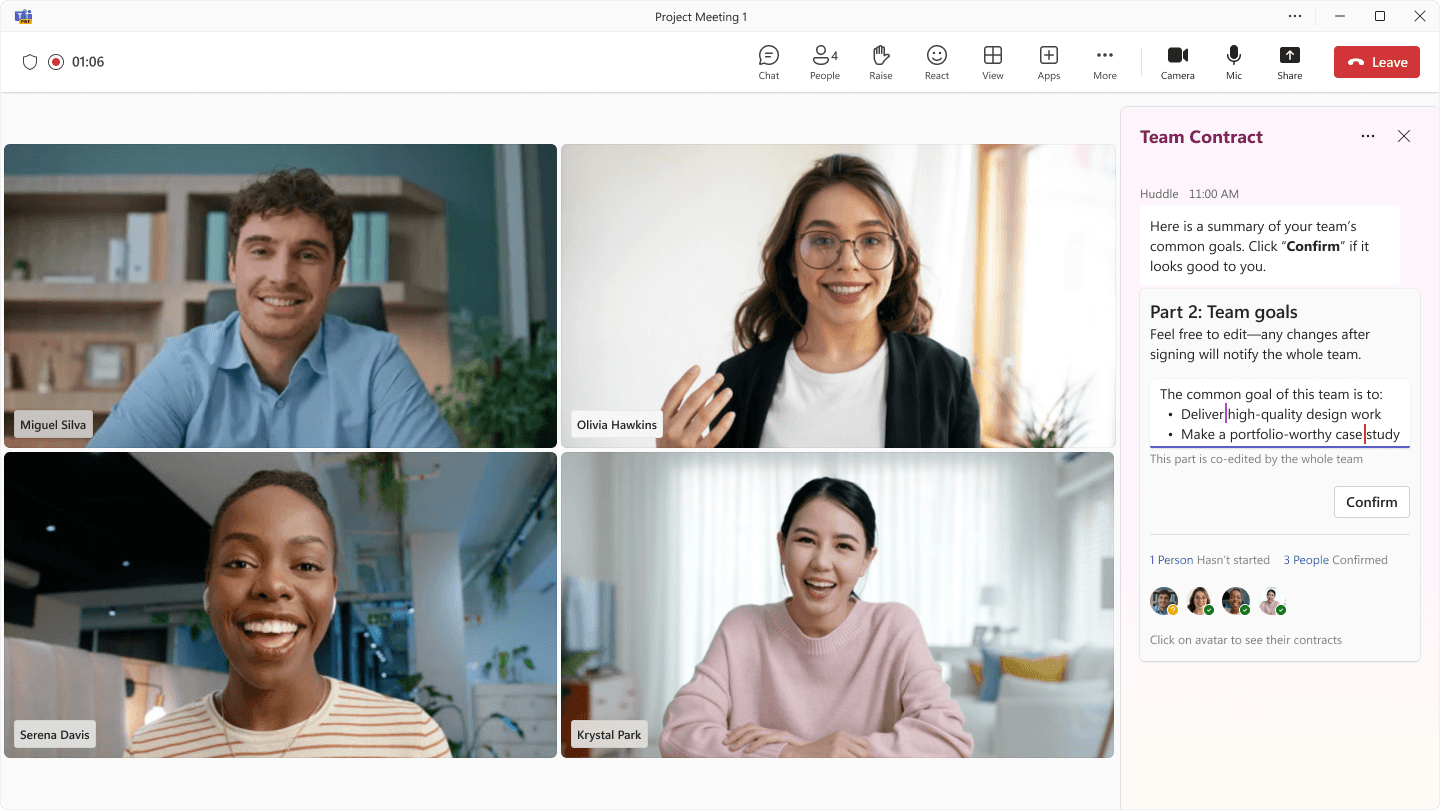
Breaks the ice in the first meeting. Huddle listens to introductions and synthesizes a team agreement including roles, goals, and meeting schedules.
Breaks the ice in the first meeting. Huddle listens to introductions and synthesizes a team agreement including roles, goals, and meeting schedules.
Create a bio
Create a bio
Share background, skills, and role preferences while Huddle listens.
Share background, skills, and role preferences while Huddle listens.
Find common goal
Find common goal
Huddle synthesizes individual goals into shared objectives.
Huddle synthesizes individual goals into shared objectives.
Schedule meetings
Schedule meetings
Huddle finds common meeting times and adds them to the calendar.
Huddle finds common meeting times and adds them to the calendar.
2
2
Intelligent Reflection
After meetings, students are prompted to write reflections. Huddle analyzes these to provide personalized coaching and recommendations.
After meetings, students are prompted to write reflections. Huddle analyzes these to provide personalized coaching and recommendations.
Personal Reflection
Personal Reflection
Reflect on your group project experience and collaboration dynamics.
Reflect on your group project experience and collaboration dynamics.
AI Coaching
Receive AI-powered analysis and actionable recommendations.
Receive AI-powered analysis and actionable recommendations.
From Research to Reality
From Research to Reality
Design Iterations
Round 1: Concept Testing
Validating initial concepts through mid-fidelity prototypes with students and faculty.
Validating initial concepts through mid-fidelity prototypes with students and faculty.
Ideation Phase
Ideation Phase
Sketched low-fidelity concepts, then built clickable mid-fidelity prototypes
Sketched low-fidelity concepts, then built clickable mid-fidelity prototypes
Participants
Participants
3 UW Master’s Students (HCDE, MechE) + 2 HCDE Professors
3 UW Master’s Students (HCDE, MechE) + 2 HCDE Professors
Duration
Duration
Student sessions: 1 hour;
Professor sessions: 30 minutes
Student sessions: 1 hour;
Professor sessions: 30 minutes
Method
Method
Mid-fidelity clickable prototypes and comparative concept evaluation
Mid-fidelity clickable prototypes and comparative concept evaluation
01
01
Meeting Interface Simplicity
“I think if you’re having a conversation with people, and everyone is having things pop up in the chat by an AI bot, it’s distracting.”
“I think if you’re having a conversation with people, and everyone is having things pop up in the chat by an AI bot, it’s distracting.”
— P10, Student
— P10, Student
Finding
Finding
Participants wanted a lower cognitive load during meetings, through clearer visual cues, intuitive navigation, and minimal text, along with more focus on the conversation rather than the interface.
Participants wanted a lower cognitive load during meetings, through clearer visual cues, intuitive navigation, and minimal text, along with more focus on the conversation rather than the interface.
Improvement
Improvement
Create a minimalist interface that reduces distractions during meetings, keeps key functions within easy reach, and uses shorter text throughout.
Create a minimalist interface that reduces distractions during meetings, keeps key functions within easy reach, and uses shorter text throughout.
Before
Before
Distracting Popups
Distracting Popups


After
After
Minimalist Interface
Minimalist Interface

02
02
Team Collaboration Support
“It would be helpful to have both a shared team goal and individual goals for each member. That way, everyone knows what they’re working toward together, but also what’s expected of them individually.”
“It would be helpful to have both a shared team goal and individual goals for each member. That way, everyone knows what they’re working toward together, but also what’s expected of them individually.”
— P8, Student
— P8, Student
Finding
Finding
Participants described recurring challenges with uneven participation and wanted shared team expectations that would complement individual goals, so everyone would understand both team and personal expectations.
Participants described recurring challenges with uneven participation and wanted shared team expectations that would complement individual goals, so everyone would understand both team and personal expectations.
Improvement
Improvement
Rebalance the team contract to pair individual profiles with team agreements, keeping room for both personal and collective goals.
Rebalance the team contract to pair individual profiles with team agreements, keeping room for both personal and collective goals.
Before
Before
Individual Profiles
Individual Profiles

After
Shared Agreements
Shared Agreements
03
03
Reflection Feature Customization
“I think the ratings for communication and task progress can be shared with the instructor and the team. The reflection itself, like writing about it, is almost like your own journal about project progress.”
“I think the ratings for communication and task progress can be shared with the instructor and the team. The reflection itself, like writing about it, is almost like your own journal about project progress.”
— P9, Student
— P9, Student
Finding
Finding
Participants had diverse views on the most useful reflection features, with some preferring personal journals and others favoring structured questions and feedback opportunities with instructors.
Participants had diverse views on the most useful reflection features, with some preferring personal journals and others favoring structured questions and feedback opportunities with instructors.
Improvement
Improvement
Redesign the reflection feature so participants can choose what to reflect on and whom to share it with, whether themselves or instructors.
Redesign the reflection feature so participants can choose what to reflect on and whom to share it with, whether themselves or instructors.
Before
Before
Fixed Reflections
Fixed Reflections

After
After
Customizable Reflections
Customizable Reflections

Round 2: Usability Testing
Validating high-fidelity prototypes through task-based testing with students and faculty.
Validating high-fidelity prototypes through task-based testing with students and faculty.
Prototyping Phase
Prototyping Phase
Built high-fidelity prototypes informed by concept testing findings
Participants
Participants
4 UW students (3 HCDE master’s, 1 Physics PhD) + 1 HCDE professor
Duration
Duration
Student sessions: 45 minutes;
Professor session: 30 minutes
Method
Method
Task-based, high-fidelity clickable prototype evaluation
01
01
AI Prompt Overload
“This is a lot of text. Maybe the silence could be made shorter if the text is a little more crisp… I’m spending that time reading it when I could get to know the people who are in the call.”
“This is a lot of text. Maybe the silence could be made shorter if the text is a little more crisp… I’m spending that time reading it when I could get to know the people who are in the call.”
— P16, Student
— P16, Student
Finding
Finding
Participants needed more time than the assumed 10 seconds to read AI prompts, and perceived the text as excessive. Reading during group conversations created awkward pauses and disrupted meeting flow.
Participants needed more time than the assumed 10 seconds to read AI prompts, and perceived the text as excessive. Reading during group conversations created awkward pauses and disrupted meeting flow.
Improvement
Improvement
Reduce the number of AI prompts users need to read when creating a team contract. Make prompts more concise and eliminate unnecessary conversational elements.
Reduce the number of AI prompts users need to read when creating a team contract. Make prompts more concise and eliminate unnecessary conversational elements.
Before
Before
Lengthy Prompts
Lengthy Prompts

After
After
Concise Prompts
Concise Prompts

02
02
Speaking Sequence Confusion
“It’s kinda hard to keep track of like who who’s going for second, 3rd or 4th. But I don’t know if, like I care, and I don’t know who the 3 out of 4 people is.”
“It’s kinda hard to keep track of like who who’s going for second, 3rd or 4th. But I don’t know if, like I care, and I don’t know who the 3 out of 4 people is.”
— P13, Student
— P13, Student
Finding
Finding
When creating a team contract, participants were uncertain about the speaking order suggested by AI prompts, and found status indicators such as “3/4 team members have shared” unclear.
When creating a team contract, participants were uncertain about the speaking order suggested by AI prompts, and found status indicators such as “3/4 team members have shared” unclear.
Improvement
Improvement
Redesign the status indicator to show who has spoken and who has not.
Before
Before
Unclear Status
Unclear Status

After
After
Clear Status
Clear Status

03
03
Contract Preview Difficulty
“I had to click ‘see more’ to read other team members’ information. I’d prefer a table with columns (Name, Background, Skills) instead of full sentences for easier scanning.”
“I had to click ‘see more’ to read other team members’ information. I’d prefer a table with columns (Name, Background, Skills) instead of full sentences for easier scanning.”
— P15, Student
— P15, Student
Finding
Finding
Participants had difficulty previewing the team contract: a small display window forced repeated clicks on “see more” to view member details, and the full-sentence format made scanning difficult.
Participants had difficulty previewing the team contract: a small display window forced repeated clicks on “see more” to view member details, and the full-sentence format made scanning difficult.
Improvement
Improvement
Restructure the content layout, such as switching to a table format, to enhance readability and reduce repetitive clicking.
Restructure the content layout, such as switching to a table format, to enhance readability and reduce repetitive clicking.
Before
Before
Full-Sentence Format
Full-Sentence Format

After
After
Scannable Table
Scannable Table

04
04
AI Reflection Inauthenticity
“I don’t know if I want this. Maybe other people might want this, but I probably wouldn’t. Because it’s a personal reflection, and I don’t want it to be an AI reflection.”
“I don’t know if I want this. Maybe other people might want this, but I probably wouldn’t. Because it’s a personal reflection, and I don’t want it to be an AI reflection.”
— P14, Student
— P14, Student
Finding
Finding
Participants did not want AI to generate their personal reflections, viewing this as something that should come from within themselves.
Participants did not want AI to generate their personal reflections, viewing this as something that should come from within themselves.
Improvement
Improvement
Remove AI-generated reflections and support authentic input with AI editing assistance.
Remove AI-generated reflections and support authentic input with AI editing assistance.
Before
Before
AI-Generated Reflections
AI-Generated Reflections

After
After
Authentic Reflections
Authentic Reflections

Ethical Considerations
Preserving Human Agency
Issue: AI integration risks shifting control from students to algorithms, weakening pedagogical relationships.
Issue: AI integration risks shifting control from students to algorithms, weakening pedagogical relationships.
Address: Our design ensures that students and instructors retain full authority over AI-generated suggestions and can easily override automated outputs.
Address: Our design ensures that students and instructors retain full authority over AI-generated suggestions and can easily override automated outputs.
Supporting Equity & Access
Issue: AI platforms may exacerbate inequalities if students have unequal access or varying digital literacy.
Issue: AI platforms may exacerbate inequalities if students have unequal access or varying digital literacy.
Address: We prioritized simple, intuitive design over complex features, using clear visual cues and universal icons to make the platform accessible.
Address: We prioritized simple, intuitive design over complex features, using clear visual cues and universal icons to make the platform accessible.
Reflections & Learnings
Impact Summary
Literature Sources
Literature Sources
23
23
Interviews
7
7
Testing Participants
Testing Participants
10
10
Design Changes
Design Changes
10+
10+
Stakeholder Outcomes
‧ Provided research-backed evidence for where AI can meaningfully support student teams without replacing human judgment.
‧ Provided research-backed evidence for where AI can meaningfully support student teams without replacing human judgment.
‧ Delivered a high-fidelity prototype to Microsoft Azure that validated core responsible-AI principles.
‧ Delivered a high-fidelity prototype to Microsoft Azure that validated core responsible-AI principles.
What I Would Do Differently
1. Improving Participant Recruitment
1. Improving Participant Recruitment
Several students canceled at the last minute or missed the testing sessions. In the future, I would schedule sessions closer to the testing dates, send reminders, and slightly overbook to account for no-shows.
Several students canceled at the last minute or missed the testing sessions. In the future, I would schedule sessions closer to the testing dates, send reminders, and slightly overbook to account for no-shows.
2. Researching Existing and Emerging AI Features
2. Researching Existing and Emerging AI Features
Earlier research into existing and emerging AI features would have informed our design decisions, reduced feature overlap, and helped us avoid rebuilding capabilities that already exist elsewhere.
Earlier research into existing and emerging AI features would have informed our design decisions, reduced feature overlap, and helped us avoid rebuilding capabilities that already exist elsewhere.
3. Building a More Flexible Timeline
3. Building a More Flexible Timeline
Our initial schedule was rigid and left little room for unexpected delays. Building in some buffer time, while still keeping clear milestones, would make the project plan more adaptable and easier to manage.
Our initial schedule was rigid and left little room for unexpected delays. Building in some buffer time, while still keeping clear milestones, would make the project plan more adaptable and easier to manage.
Future Directions
Broadening Scope
Examine how communication and collaboration challenges shift across diverse cultural backgrounds, disciplines, institutions, project types, and time zone differences.
Examine how communication and collaboration challenges shift across diverse cultural backgrounds, disciplines, institutions, project types, and time zone differences.
Examine how communication and collaboration challenges evolve across diverse cultural backgrounds, academic disciplines, institutional contexts, project types, and time zone differences.
Enhancing User Testing
Use Wizard of Oz methods to simulate authentic AI interactions in real group settings, then develop an AI-backed prototype to evaluate its practical usefulness.
Use Wizard of Oz methods to simulate authentic AI interactions in real group settings, then develop an AI-backed prototype to evaluate its practical usefulness.
Use Wizard of Oz methods to simulate authentic AI interactions in real group settings, then build a working AI-backed prototype to evaluate its true usefulness in practice.
Developing Instructor Dashboard
Explore alternative strategies for faculty recruitment while placing greater emphasis on designing, testing, and refining instructor-specific features.
Explore strategies for faculty recruitment while placing greater emphasis on designing, testing, and refining instructor-specific features.
Explore alternative strategies for faculty recruitment while placing emphasis on designing, testing, and refining instructor-specific features.